Art in Conversation: An Interview with Cedric Michael Cox
Charismata, a solo exhibition of paintings by Cincinnati artist Cedric Michael Cox, was recently on view at the Xavier University Art Gallery.
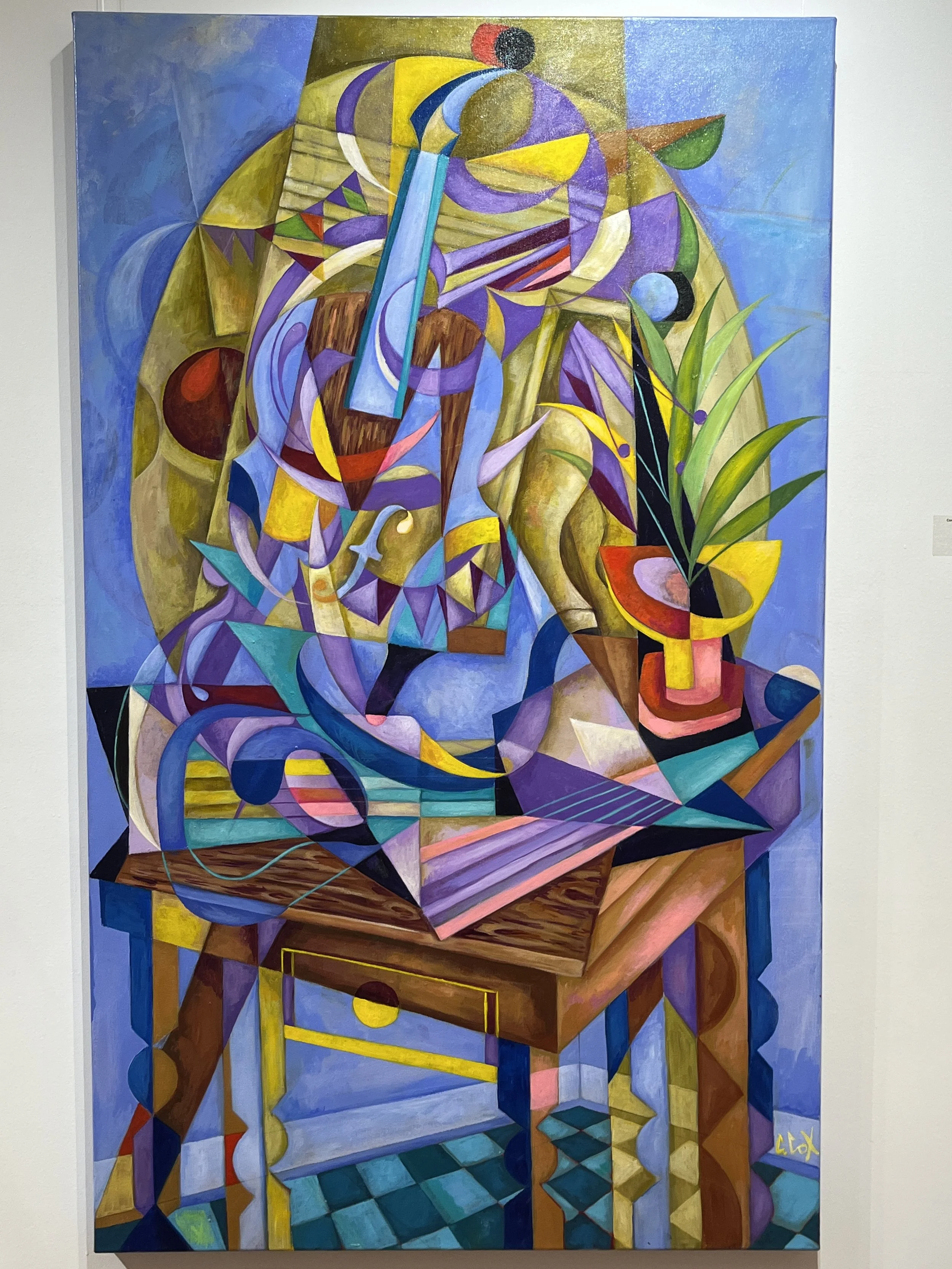
Playing with the visual celebration of “the inner combustion of sound” within his “whimsical abstractions,” Cox’s work is about more than just art history. Though it plays with the concepts of the cubist movement, Cox incorporates contemporary sentiments into each gradient and shifting line. Charismata, with 23 new works by Cox, is a crescendo of color and a wonderful exploration of what it means to “live in the moment.”
Excerpt from the discussion between Cedric Michael Cox and Caressa Layne Miles, Gallery Director, held at Xavier University Art Gallery on October 22, 2025.
Caressa: Let's talk about the influence that art history has played in your work. Obviously, that's a major theme. We see cubism. We see a lot of things at play, but you seem to push it further than that. So, there's a quality and play that are unique to your voice. Could you tell us about what drew you to the cubist movement?
Cedric: Well, cubism, it's a style of art that a lot of us are probably familiar with through the works of Picasso, Georges Braque, Juan Gris. Basically, it's the whole idea of taking an object or person and actually getting a 360 view of it. Kind of dissecting the anatomy of what we see around us and showing all perspectives all in one piece. It's the prelude to what would be abstraction and what kind of came out of the impressionist movement with artists like Paul Cézanne who was a major influence for someone like Picasso.
I am drawn to it for some reason. When I was sitting in art history class, it seemed like it clicked when we got to modern art or the modernist movement. And I remember, I was like, “Okay we got through Van Gogh… and I mean don't get me wrong… But we got through what I was familiar with in the impressionist movement, and it just started lining up. It's kind of getting groovy, you know? And then when I started looking at the works of artists after that movement like Juan Gris, Georges Braque, artists from maybe the Dada movement. But that work spoke to me because throughout my whole life I created paintings and drawings that had an all over compositional climax where the foreground and the background are one and the same. It's not about positive and negative space. It's not about this subject, this background. It's about activating the pictorial arena that we know. And negative space is just as important. I remember when drawing my characters as a kid and sitting with my dad as he was sketching, and noticing how the shapes within the negative space were just as interesting as the positive space. And then this whole attention to detail and fragmentation of form, it wasn't about what I was drawing as much as how I was drawing. I found myself being interested in patterns and shapes rather than actually the content of what I was creating. And I think that leans towards other movements in art like Art Nouveau or even Art Deco. But that's where my love came from. And of course as we know a lot of these movements I just mentioned–like Art Deco–were all derived from non-western art which was fueling a lot of the European conception of art in general. So I guess we can say that the root of what I do is a non-western style of art. And now I've taken it a step further where I actually look at some of the cubist compositions by some of the masters that inspired me and kind of take on some of the motifs. It's just a montage of different forms that I live with that help me create.
Caressa: So, we kind of touched on this already, but were there other periods of art history that moved you other than abstraction?
Cedric: Well, initially, you know, I really thought that figurative was where I wanted to go with my work. I really thought that that was where I wanted to be. And then I remember in art school, these questions would arise where they would talk about, well, “Why is the figure standing this way? What's the figure doing? What's the mood? How is light hitting the figure? What's the ethnicity of this figure? What are the clothes? Why are they wearing this?” All these questions. And as a guy who just really wants to just get in there and execute compositions that speak to me spiritually, I was like, man, I'm just going to back off of that. So there was a beginning of interest in the figure and form and other movements in art history, but I look at art history as what I see on Instagram, you know? When you're working on a painting and I look at what you're doing in your studio after it's posted, it's art history. And I also look at the artists that I know around me. The artists like Cynthia Lockheart, Mary Bar Rhodess, and so many others who are every day working and creating history that I can talk to, converse with. And it's really cool because it's right then and there. It's happening right there. So to me, art history is kind of a continuing process. And it's actually happening in real time, not just in the past, but as we exist.
Caressa: So, you kind of bring it in and incorporate it into your practice and dialogue with it in the moment. Is that true across mediums? What other art forms influence your work? Music, architecture, literature, film?
Cedric: I remember when moving to Over the Rine and remembering what my professors would tell me about “Paint what you know, draw what you know.” I started really taking on the aspect of just looking in my environment and painting my environment, drawing my environment. And so when you look at drawings like “Street Rhythms. Number 3” that's me looking at
architecture that was around me. The cracks in the pavement, the the sounds of the street, the the environment, you
know, Over the Rhine at one point in time was a place of… imperfection, if you will, where you had a fully remodeled home next to a home that's falling apart. But the cracks in the pavement, that imperfection, the tagging, not necessarily graffiti as an art form, but actually the quick tag of somebody's signature like on a brick wall. Those are the gestural movements that were kind of like the classroom for me, taking live drawing and doing a gestural rendering. That was my language. So that's a great example of how architecture played a part in my work. But
then as I was getting kind of tired of being known as the person who looks at architecture or reconfigures it and gets you to look at things differently in an urban environment, I started breaking down and just trying to find my new way of what I wanted to create because there was an essence of me wanting to create portraiture from the inside out rather than outside in. And this idea of internal human anatomy being subject matter within itself. So what would end up happening when I would look at these medical books and as you can see in this drawing “Anatomical Rhythms Number 4,” where I actually was trying to create the inner spirit of what music was doing for me. So that language that you’ll see in my work is abstract based in cubism but also it's this inner combustion of sound.
But, moving on, I found myself just getting into this American landscape painter from Philadelphia. He believed that God was in every single thing in nature like the bark on trees, the blades of grass, everything. And so there was this luminous quality in his art and then luminous quality in the force. So when I started looking at that, I wanted things to breathe to actually show the rhythm of the music of the vibration that's happening when I create work. And just within music, I think even though I use music as as a subject matter as
parts and shapes that relate to the masculine and the feminine. I think the guitar itself relates to that or reflects that. I think there's also this vibe of the musical composition being the same as artistic composition where we have parts and shapes moving as the same. a change in brush stroke being a change in volume or a gesture or a crescendo, you know.
Caressa:. So, how do you take those influences and bring them into your practice? What does a day in the studio look like for you?
Cedric: I think the day in the studio, it depends on what's going on. Like for example, getting ready for this show, it was about intense work…It's usually me painting continuously the whole time. What I found in my later years as a painter is that [the work] isn’t constantly figuring it out, lifting a brush, pushing and pulling paint, stalling, or overconcentrating on an area that's working then creating a mess. Now it's about: what is working, but you know something needs to change. And you might just sit there in that studio handling everything else. Maybe watching a movie, maybe just sitting back and then looking at the painting occasionally and just actually thinking it through. “What would happen if I changed the background to orange?” "No, that won't work." And then you sit there and then you go back to doing what you're doing. Go to a board meeting or something like that. And then and then you come back to the painting and you look at it again, you know, it wasn't even in the background. That's cool. That's great. And then it just be one little thing and change and that's all you do for that day. You're four hours in the studio, but you'll just rock out something for 30 minutes and that handles the issue. That takes you to the next level to where a few more steps and you're done. So, it's a lot more observing, a lot more living with the work and kind of existing with it and knowing what the next move is.
Caressa: Yeah. I like to say that an important step of the artistic practice is putting it across the room and just glaring at it for a couple hours.
Cedric: Exactly. Having kind of a start with the piece, but even with those moments of seeming inactivity, I was actively contemplating the work.
Caressa: I love it. So after you finally get to that point where it's finished, is that when you name it or do you have to name in mind beforehand?
Cedric: I try to name them beforehand just so that that will push my mind into maybe changing something about it to make it visually more stimulating. But that doesn't work usually. I was naming these pieces right up to the moment… Like “Glowing with Grace” that I knew that was the name. Some of this is, you know, easy to build with number one, number two, number three…. It's real simple. “Abundance number three, number four, number one.” But then there's some that just stand alone that are just a part of the ongoing journey of the whimsical abstraction that that kind of just call for something special or different and unique.
Caressa: So there's a little bit of poetry in this? It's intuition that you're building on. So, playing with an intuitive approach. Is there a methodology that you use when choosing a palette, a color palette, or is that purely intuition?
Cedric: I think color…it's intuition to a certain degree. I think there's a point where you have a game plan of where you want to start with the color. I was talking to Kelly Phelps, and we were talking about how to motivate students to push them to keep proceeding on and how to not just work straight out of the tube. And I was telling him, well, you know, we should always get the students to maybe look at art history as a reference. But what I'm interested in maybe in this figurative masterpiece, I might be interested in the olive floor next to the pink flesh tone with the turquoise gown. I'm looking at zeroing in on a certain area that's that's the next combo for one of my pieces. And those are the answers that are happening. So, I guess when you're thinking about the palette and the color and how you do that, you're pulling from all your resources that you could find to make that happen.
Watch the full interview here.